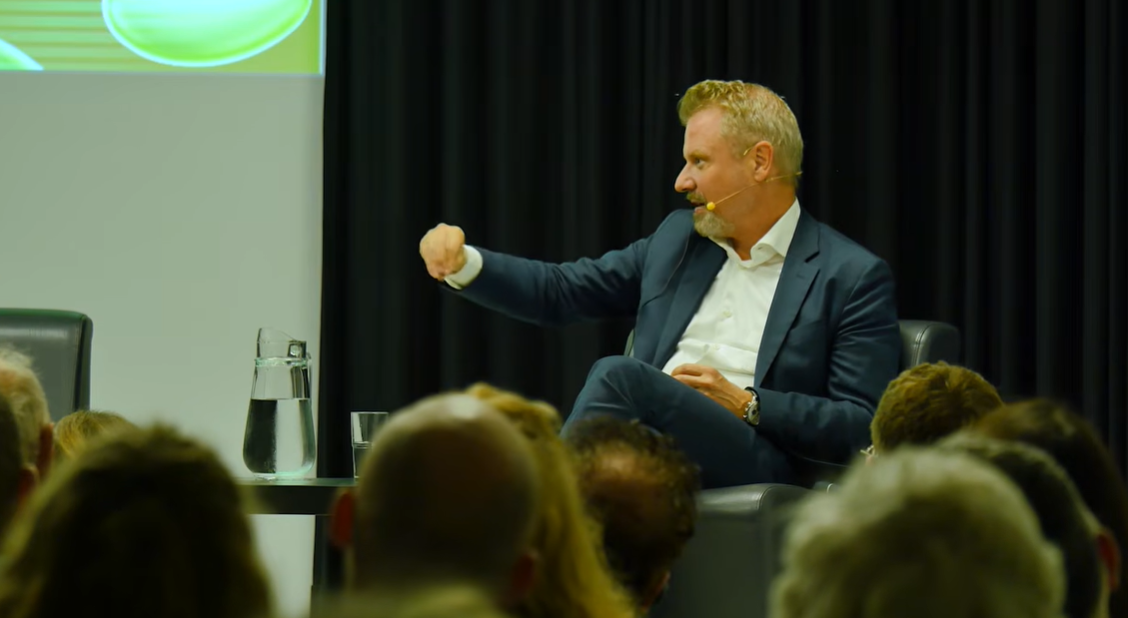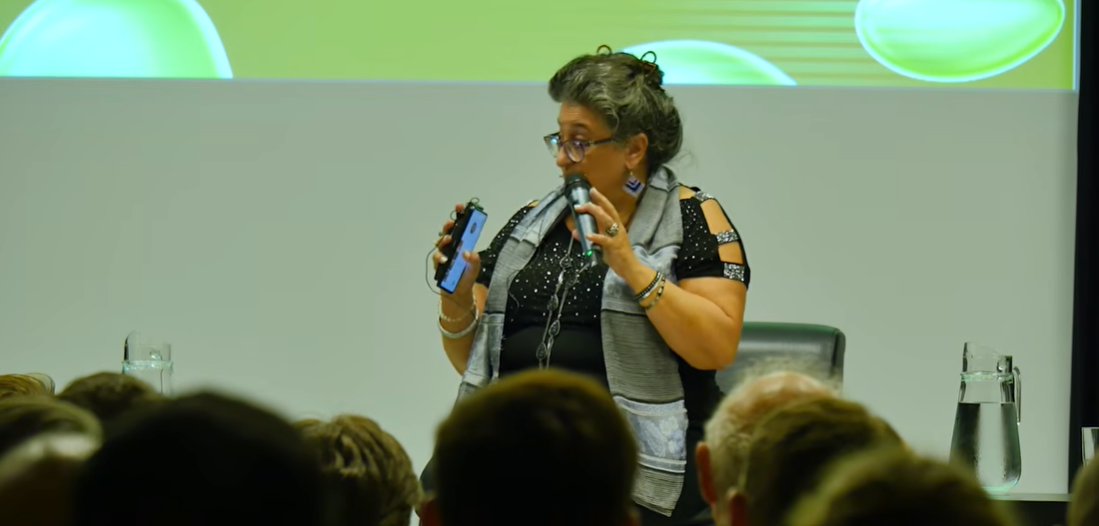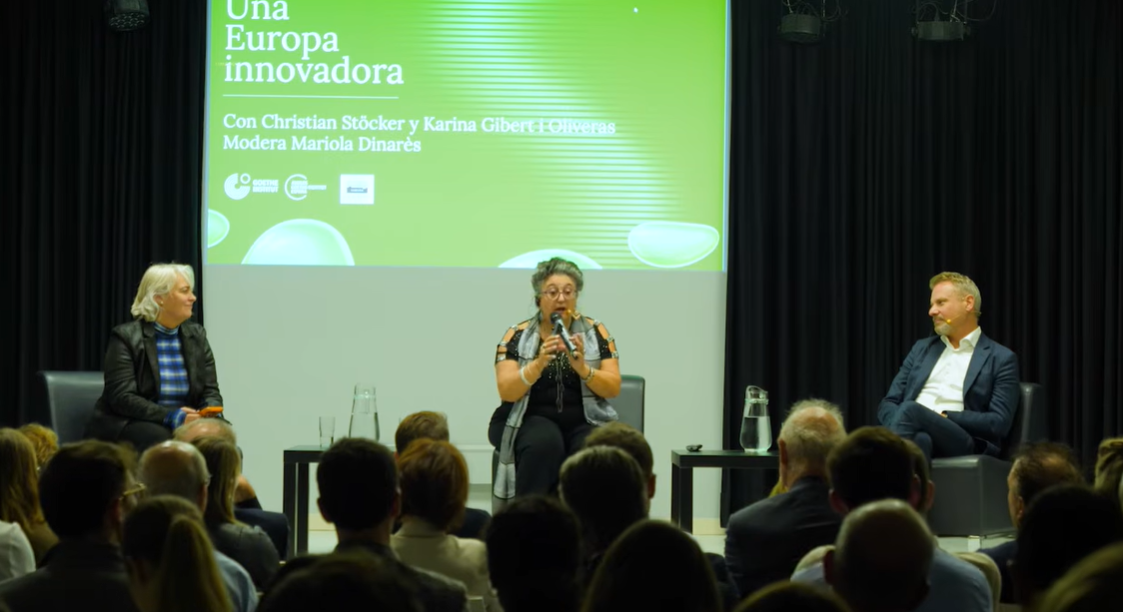
On Thursday, 29 October, the conference «An Innovative Europe» took place, jointly organised by the Goethe-Institut Barcelona and the Fundació Catalunya Europa. The event featured Christian Stöcker, one of Germany's most influential voices on innovation; Karina Gibert i Oliveras, a specialist in artificial intelligence and data science; and Mariola Dinarès, a journalist specialising in digital environments.
The aim of the meeting was to focus the debate on the need to establish a dynamic culture of technological innovation, particularly in today's global context, which is characterised by unprecedented technological acceleration.
The event began with a welcome address by the director of the Goethe-Institut Barcelona, Joachim Bernauer:
«In Europe, we do not want innovation at any cost. We do not need it if it leads to the elimination of democracy or the development of weapons of mass destruction».
The director of the Fundació Catalunya Europa, Dolors Camats, also addressed the audience:
«Bringing major European debates into everyday discussions, in order to ensure high-quality public debate and encourage critical thinking».
Both highlighted the importance of the meeting in finding ways to innovate and remain competitive while connecting these goals with European values, leaving no one behind and maintaining a commitment to justice and social cohesion.
The debate opened by focusing on one of the issues frequently raised when discussing the European Union's innovation challenges: regulation. However, as the speakers emphasised, regulation stems from the need to monitor and prevent human rights violations and, when properly designed, it can often benefit everyone. In a way, our regulatory framework is innovative in itself.
Similarly, the controversy surrounding regulation as an obstacle to innovation was described as misleading, since regulation ensures that products introduced to the market are sufficiently safe and reliable, preventing them from being defective or malicious.
The roundtable discussion began by addressing artificial intelligence (AI), which the speakers considered a clear example of the need for regulation. Nevertheless, they emphasised that the real problem does not lie in AI itself, but rather in who holds the «off switch» — in other words, who controls it.
The conversation then moved towards examining Europe's ability to establish its own position in this field, particularly considering the power the European Union already holds. The conclusion was that Europe is moving much more slowly due to its relatively low levels of investment. The speakers therefore stressed the need for Europe to develop the necessary infrastructure, such as data centres, to manage public data, without necessarily requiring vast amounts of physical space.
Artificial intelligence was not the only topic discussed. When referring to innovation, the speakers also included industries such as satellites, the green transition and the electrification of cars. However, the conclusion remained much the same: Europe needs to recover some of its productive capabilities in terms of innovation, particularly when it comes to retaining talent. Many people who receive their education and training in Europe end up working and generating economic value abroad.
This shortcoming can partly be explained by the lack of venture capital in Europe, which leads to products designed by Europeans being manufactured and commercialised elsewhere. It is essential to find an innovation model that prevents this from happening without compromising our values.
Regarding possible solutions to Europe's stagnation and the search for its own innovation model, several measures were proposed. These included making bureaucracy more flexible, less burdensome and more efficient, as well as finding ways to ensure that money invested in research can be effectively put to use by opening up markets and bringing products to market.
The speakers also pointed out that current measures of value, such as GDP, often fail to reflect what truly matters to people's lives. «Quality of life is not reflected in GDP».
Another implicit proposal, therefore, was to rethink certain indicators, since the criteria we establish to evaluate things ultimately shape how they develop, as they tend to evolve towards achieving the highest possible score.
The closing remarks raised the question of whether we are experiencing a change of era. We are witnessing profound structural changes in the way we work, travel and communicate...
«The decisions we make now will shape the world to come».
It is up to us to make Europe an attractive place for the very best talent, to create a new culture of innovation and to become a benchmark for a world moving towards sustainable dynamism and a better future than the one we are presented with today.