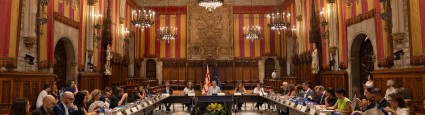
The Café Europa session in September was held in a special format from Brussels, on the occasion of the 40th anniversary of Spain’s accession to the European Union. The session featured Gianluca Spinaci, advisor to the Committee of the Regions, and Blanca Soler, head of the Barcelona Provincial Council office in Brussels. Moderated by Dolors Camats, the debate highlighted the fundamental role of local and regional authorities in European building and the challenges that cohesion policy faces today.
Spinaci opened the debate with a historical and optimistic perspective, noting that European municipalism is “the foundation of democracy” and that proximity is key to maintaining citizens’ trust. He emphasized that the majority of public investments in Europe are carried out by local and regional institutions, and that without them, the implementation of the Green Deal would be impossible. He also warned of the threats posed by the centralization of the new multiannual financial framework, which could leave territories without a voice.
For her part, Blanca Soler offered a practical and close-to-the-ground perspective, reviewing the pioneering role of the Barcelona Provincial Council in opening an office in Brussels and its work supporting municipalities. She highlighted that EU accession opened a “window of opportunity” for municipalities, both in terms of financing and networks of cooperation and visibility. She also argued that, despite the progress made, it is necessary to continue fighting against the risk of backsliding that would result from recentralizing funds and competences.