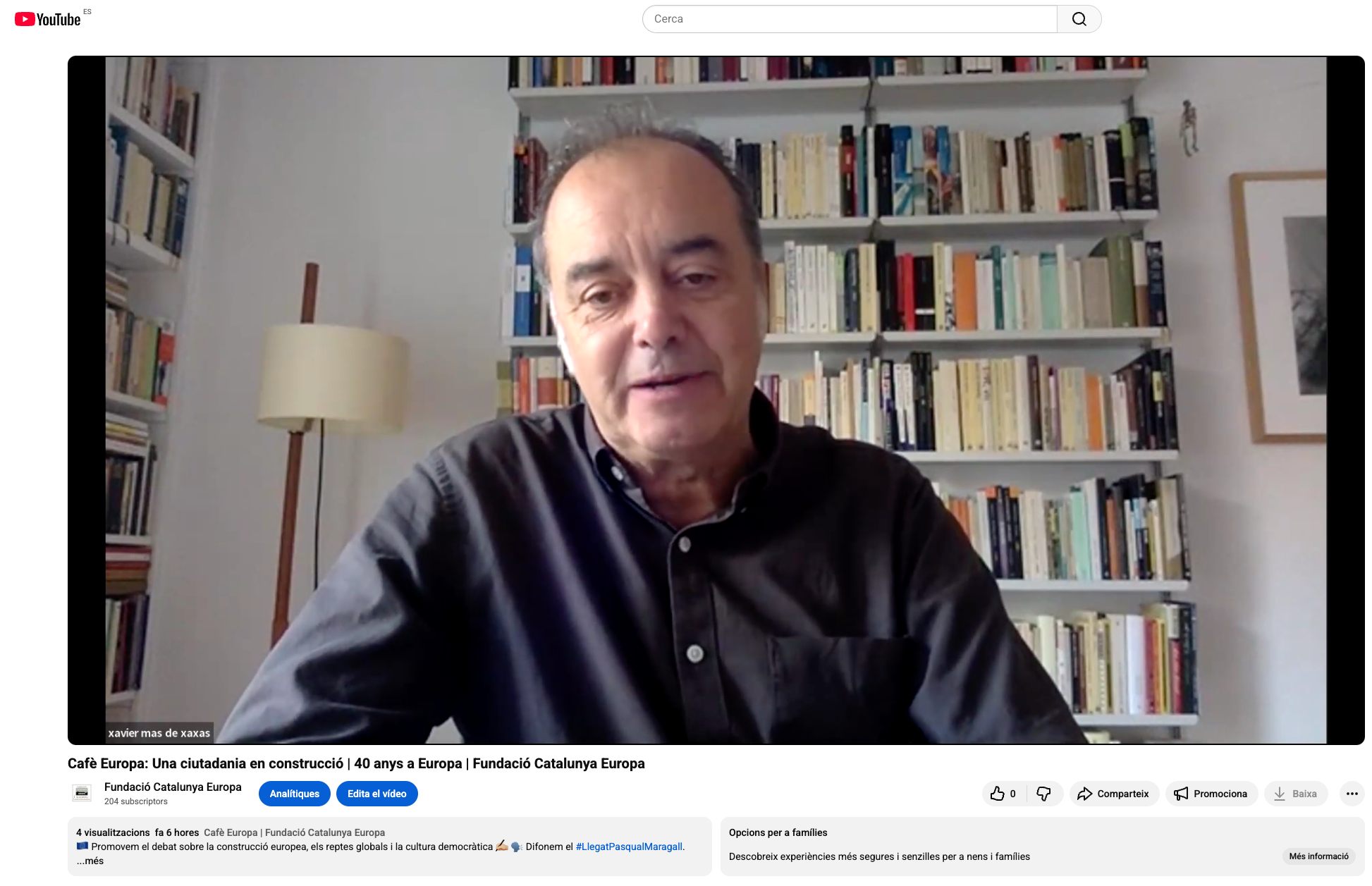
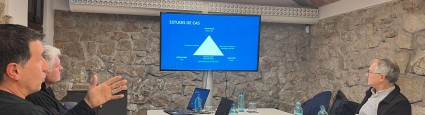
On October 31, we held an intergenerational conversation to explore how our understanding of citizenship, politics, and the European project has evolved. The discussion featured Xavier Mas de Xaxàs, recipient of the 2019 Salvador de Madariaga European Journalism Award, Paola Lo Cascio, Italian historian and political scientist and author of Pasqual Maragall and the Nearby Europe, and Mariona Muns, a Law and Political Science student at the University of Girona and delegate of the working groups of Team Europe Catalonia.
A young perspective on Europe
The youngest voice in the debate, Mariona Muns, acknowledged that her generation “has grown fully within the EU; it is an everyday reality. Our trajectory is shaped by the benefits of the EU, but we also feel it is distant and bureaucratic.”
Mariona emphasized the need for the European Union to better connect with young citizens: “I wonder if we are truly experiencing the work the EU is doing; we need to see and feel it. Policies must translate into opportunities to have good living conditions, housing, and healthcare, and this is very difficult for young people to perceive. The EU must make an effort to reach us.”
Historical memory and European diversity
Paola Lo Cascio offered a historical perspective on the European project: “In Spain, despite criticisms of the EU for austerity policies, there has not been a widespread feeling among citizens that leaving the Union would be better, because joining meant leaving the dictatorship.”
On the EU’s ongoing challenges regarding diversity and equality among countries, she added: “Especially during the 2008 crisis, but also in many recent decisions, there has been a sense of northern superiority over the south. The EU shows a certain inability to embrace diversity, which is a major problem because we must recognize that the new Europeans are neither white nor Christian.”
Despite these difficulties, the historian highlighted the hope inspired by today’s youth: “There is a certain awareness among young people of what Europe has achieved throughout history… the wave of mobilizations around Gaza speaks very positively of the youth, of a discourse that goes beyond what is happening in Palestine specifically.”
Europe facing current challenges
Xavier Mas de Xaxàs reflected on the successes and shortcomings of the European project: “We have built a European Union that has worked very well, but it now has gaps; we must make it more transparent, closer, and stronger.”
He also noted that the colonial past and Western dominance still weigh heavily: “White Europeans dominated the world until the 1960s, and that legacy still matters.”
Regarding the future, he envisioned “a Europe of cities, an idea of Pasqual Maragall, where a fully European citizenship will have emerged, without the awareness that my interests as a Spaniard are above those of someone from Italy.” He concluded on an optimistic note: “In a world marked by authoritarianism and nationalism, Europe will have a very important leadership role.”
A future to build
In the final segment of the debate, Mariona Muns echoed Paola Lo Cascio’s optimism: “It is true that in recent months young people have shown that we have a much stronger foundation and that we need to be heard.”
However, she also expressed some disappointment with institutional responses to recent conflicts: “We have seen that the EU and institutions have not been up to the task; when the war in Ukraine broke out, many sanctions were imposed, but the EU took two years to mention Gaza. This has greatly disappointed young people; we cannot see the EU negotiating human rights depending on geopolitics and vested interests. The EU must know where to act.”
Finally, Mariona called for a more agile and modern Union: “The EU’s founding treaties were designed for a very different union… we need a much more agile EU, with institutions capable of responding to crises more quickly.”
Listen on Spotify